
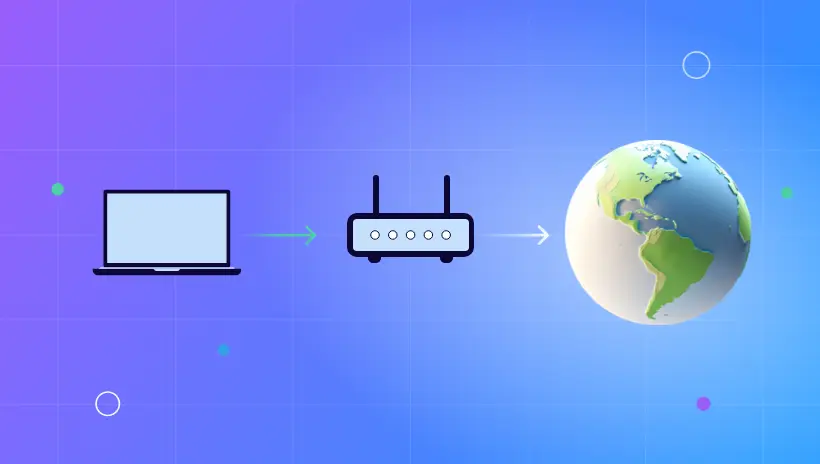
Have you ever wondered how all the devices in your home – your laptop, smartphone, smart TV, and even your smart fridge – can simultaneously connect to the internet using just one internet connection? The unsung hero behind this everyday miracle is Network Address Translation (NAT).
While often working silently in the background of your router, NAT plays a absolutely crucial role in the internet’s current architecture. Without it, the internet as we know it simply couldn’t function. Let’s dive into what NAT is, how it works, and why it’s so indispensable.
The Problem: Not Enough IP Addresses
To understand why NAT is so important, we first need to talk about IP addresses. Every device connected to the internet needs a unique address to send and receive data. This is an IP address.
The internet primarily uses IPv4 (Internet Protocol version 4) addresses. An IPv4 address is a 32-bit number, usually represented as four sets of numbers separated by dots (e.g., 192.168.1.1). The problem? There are only about 4.3 billion unique IPv4 addresses available.
In a world with billions of people, each owning multiple internet-connected devices, 4.3 billion addresses are nowhere near enough. This scarcity of unique IPv4 addresses is the fundamental problem that NAT helps to solve.
How NAT Works: The “Translator” of Your Network
Think of your home router as a security guard at the entrance of a building. Inside the building (your home network), everyone has a “local” name (a private IP address like 192.168.1.100, 10.0.0.5, or 172.16.0.12). These private IP addresses are not unique on the internet; many homes use the exact same private ranges.
When someone inside wants to send a letter outside the building (to the internet), they hand it to the guard. The guard (your router with NAT enabled) takes the letter, replaces the “local” return address with the building’s official “public” return address (your public IP address provided by your Internet Service Provider), and sends it out.
When a reply letter comes back to the building’s public address, the guard remembers who originally sent the outgoing letter and delivers the reply to the correct person inside.
Here’s a breakdown of the process:
- Private IP Addresses: Devices on your local network (LAN) are assigned private IP addresses. These addresses are only valid within your local network and cannot be directly routed on the public internet.
- Public IP Address: Your router has one (or sometimes a few) public IP addresses assigned by your ISP. This is the address that the rest of the internet sees.
- Translation: When a device on your private network sends data to the internet, NAT on your router translates the device’s private IP address and port number into your router’s public IP address and a unique port number.
- Tracking: The router keeps a table of these translations. When a response comes back from the internet, the router looks up its translation table to determine which internal device the data is intended for and forwards it accordingly.
Types of NAT
While the basic principle remains the same, there are a few types of NAT:
- Static NAT: One-to-one mapping of a private IP to a public IP. Less common for home use.
- Dynamic NAT: Maps private IPs to a pool of public IPs.
- Port Address Translation (PAT) / NAT Overload: This is the most common type, especially for home routers. It allows many internal private IP addresses to share a single public IP address by using different port numbers.
Why the Internet Can’t Work Without NAT (Currently)
- IPv4 Address Conservation: This is the primary reason. Without NAT, every single device connected to the internet would need its own unique public IPv4 address. We simply ran out of these addresses long ago. NAT effectively allows tens of billions of devices to share a limited pool of 4.3 billion addresses.
- Security Layer: NAT provides a basic layer of security. Because devices on your internal network use private IP addresses, they are not directly visible or addressable from the public internet. This makes it harder for external entities to initiate connections to your internal devices without your router explicitly allowing it (e.g., through port forwarding).
- Simplicity for Home Networks: NAT simplifies network management for home users. You don’t need to manually configure unique public IPs for all your devices; your router handles all the complex addressing and translation automatically.
The Future: IPv6
While NAT has been a phenomenal stop-gap solution, it does introduce some complexities (like issues with direct peer-to-peer connections without special configuration). The long-term solution to the IP address shortage is IPv6.
IPv6 uses 128-bit addresses, which provides an astronomically larger number of unique addresses (approximately 340 undecillion – that’s 340 followed by 36 zeros!). With IPv6, every device in the world could theoretically have its own unique public IP address, largely eliminating the need for NAT.
However, the transition from IPv4 to IPv6 is a massive undertaking that will take many years. In the meantime, NAT remains a critical component of how the internet functions today.
Conclusion
NAT is a clever workaround that allows us to continue using the limited IPv4 address space while the internet slowly transitions to IPv6. It’s the silent workhorse in your router that enables your entire household to surf, stream, and connect simultaneously without skipping a beat. So, the next time you connect multiple devices to your home Wi-Fi, give a little nod to Network Address Translation – the unsung hero keeping the internet afloat!